
Neuraplex overview
Built by clinicians, co-designed by all users, for every step of the neurodevelopmental pathways
Neuraplex is a clinician-led platform that supports the whole neurodevelopmental pathway, from first enquiry to discharge, for children, young people and adults.
Neuraplex is designed by a practising Consultant Neurodevelopmental Paediatrician around the realities of autism, ADHD and wider neurodevelopmental assessment. It is not adapted from a generic healthcare system.
It has been in real-world use for four years in an independent clinical service, and has been shaped through co-design with neurodivergent people, families, clinicians and schools.
Registration
First appointment
Diagnostic feedback
Report complete
Supported workflow
Information from the referral, family, school and GP flows into the assessment appointments and the MDT, and builds the report as it goes.
At a glance
Neuraplex covers every aspect of the neurodevelopmental pathways, from referral to discharge
- Referral
- Registration
- Pre-assessment
- Triage
- Waiting Well
- Assessment
- Diagnosis
- Treatment
- Post-diagnostic support
- Discharge
| Pathways |
|
| Population |
|
| Intended use | Pathway management, information gathering, workflow coordination and clinical documentation. Not autonomous diagnosis or treatment decisions. |
Principles of Neuraplex
One platform across organisations
Much of the transformation in neurodevelopmental services involves organisations that use different electronic patient records. Clinicians working in three different electronic patient records, for example, may not be able to access each other's information.
The most suitable clinician for each part of the pathway, whichever organisation employs them.
Cover across organisations when staff are absent, vacancies arise or demand rises.
Shared MDTs, one view of waiting patients and consistent pathways across the system.
Neuraplex is here as a supporting tool to influence what the leaders and visionaries in the NHS are already trying to achieve. NHS organisations have the vision to unite several trusts and organisations, and their strong vision can be facilitated with the use of Neuraplex.
“The NHS is the most extraordinary health service in the world because of its people. Its senior leaders, clinicians and administrators already have the vision to transform neurodevelopmental care. Neuraplex is here to support them.”
- A data sharing agreement
- A joint data protection impact assessment
- Role-based access for each organisation's staff
- Shared clinical governance and safety oversight
What the NHS, families and staff say
Demonstrations to Health Innovation East Midlands and two NHS trusts, and feedback from Neuraplex co-design workshops.
“…Neuraplex appears to be attempting to support the entire operational pathway rather than just one stage and has developed a good Waiting Well offer.”Health Innovation East Midlands, September 2026
There is huge potential with this tool.
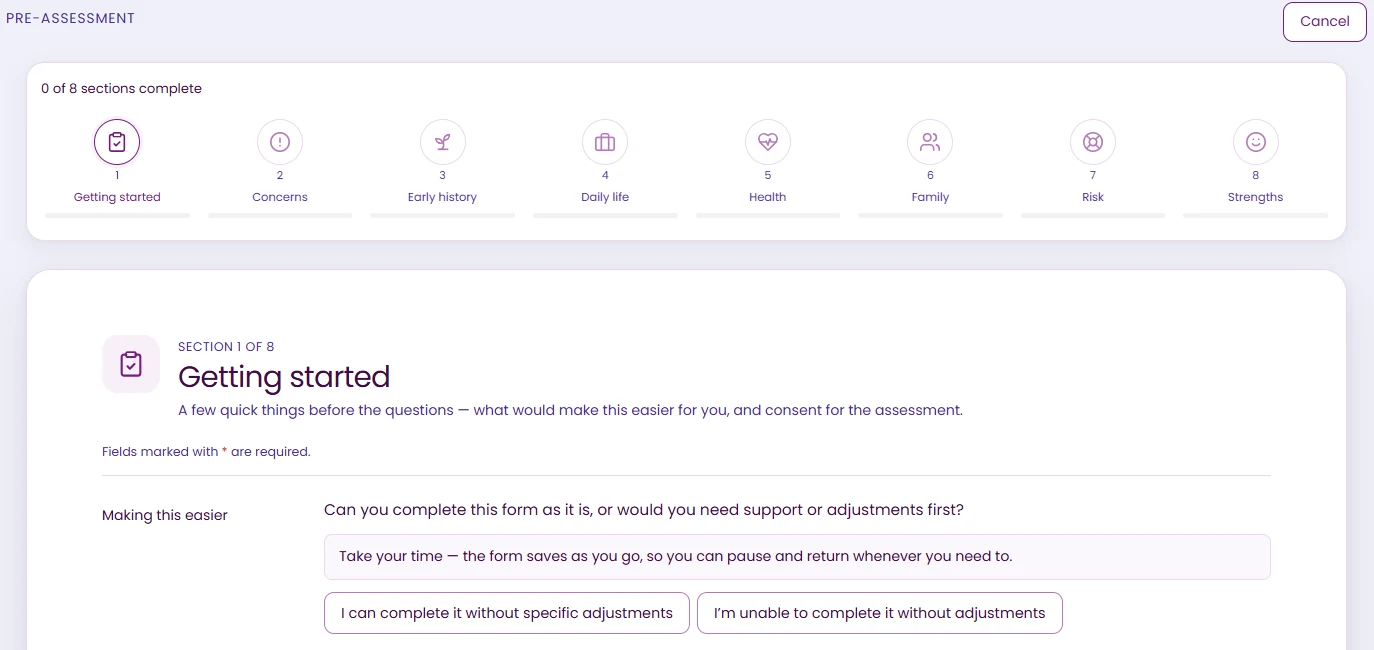
In the pre-assessment form, minimalistic with images on a timeline at the top, was very easy to follow. Font and purple and white colour combination was good, calming and friendly.
Speech-to-text microphone made it easier and quicker to fill. Yes/No section was very easy to use. Final report was very detailed, and the short version was very helpful.
Navigation is extremely simple; you can move through each section without any confusion.
The system makes it so easy for professionals to share information and work holistically. Writing reports is quicker and more organised.
It's secure, intuitive, and incredibly easy to use. Finding the right form or specific details, such as family history, takes seconds.
…designed by people who understand what a neurodevelopmental assessment actually involves.
Sources: Health Innovation East Midlands demonstration feedback, September 2026; anonymous NHS manager feedback, n = 4, August to October 2026; Neuraplex co-design workshops.
Neuraplex preview
Screens from the platform, using demonstration records.

Explore Neuraplex
See Neuraplex in action
Book a demonstration for your service.
Neuraplex
Neuraplex preview
Seamless flow of information from family to clinicians to report.
- 1
The person or family complete information
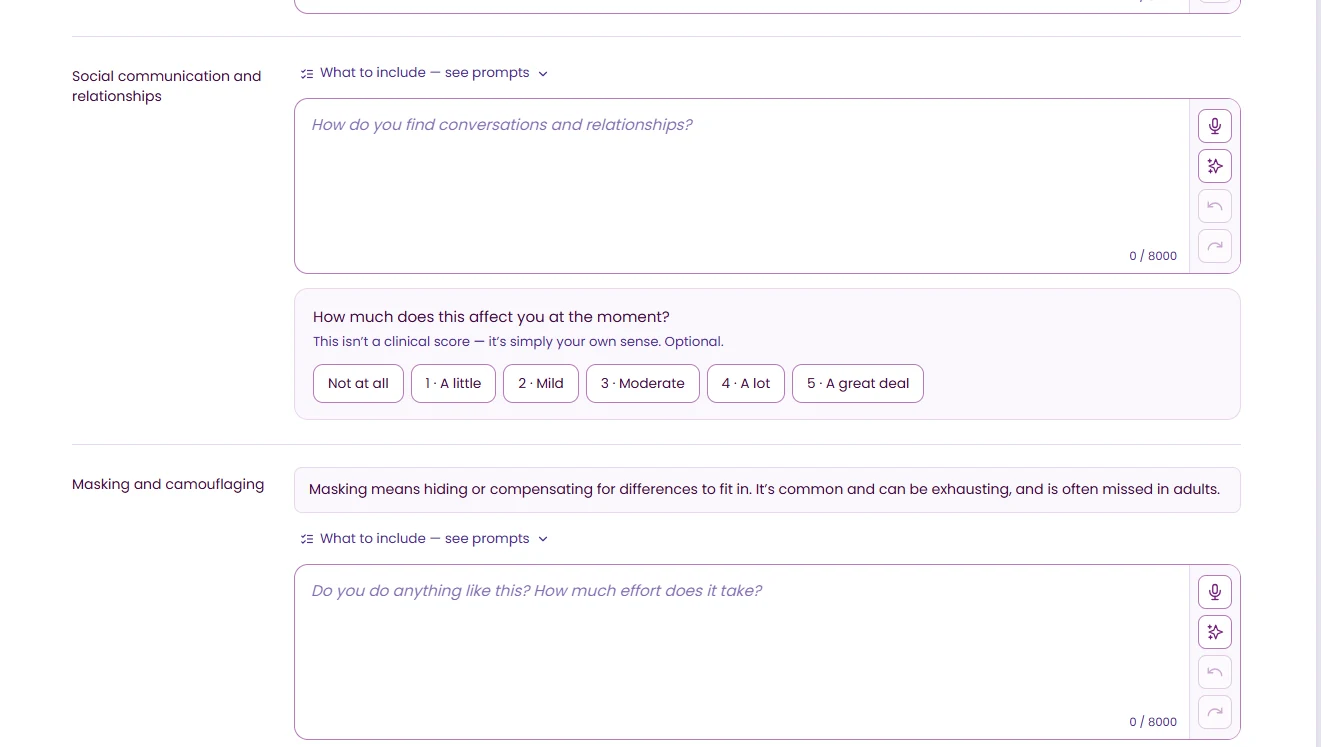
The person, or their family or carer, completes one online pre-assessment before the first appointment, at their own pace, with prompts, voice-to-text and their progress shown as they go.
- 2
Information is triaged
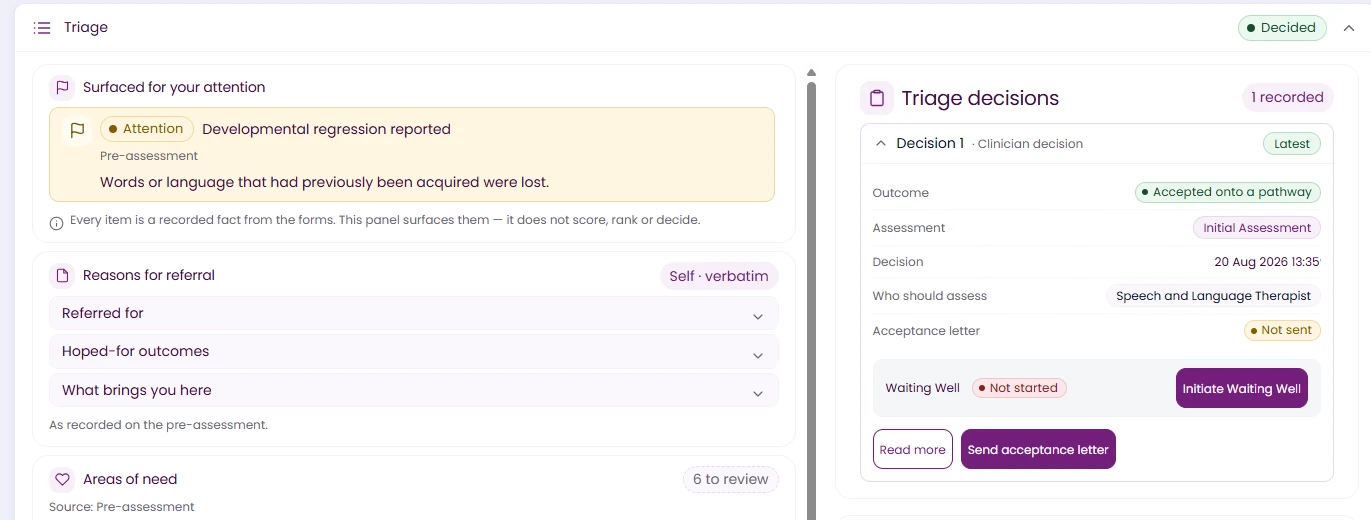
Safeguarding concerns, vulnerabilities and co-occurring conditions are surfaced for review at triage, and the clinician agrees the right pathway.
- 3
Waiting Well, if the wait is longer than expected
If waiting is expected to be longer than usual, Waiting Well support can be included, with needs-led information, resources and check-ins while the person waits.
- 4
Clinicians analyse, edit, add and enhance
Clinicians work with the information in their own clinics, with everything in one live view. Each part of the assessment is sent with one click, and the record moves forward as each part is completed. Try it: press Send.
Alex Age 9 · Autism pathway- Completed
- In process
- Not started
- Not sent
- Not reached
- Pre-assessment
- Triage
- Waiting Well
- Assessment
Sent to parent or carer
- Pre-assessment information
- Parent questionnaire
- School questionnaire
- Reasonable adjustments request
Assessment
- Developmental history appointment
- Observation appointment
- School information request
Press Send to send each part to the family
The example uses made-up information.
- 5
School or other information
Schools, colleges and other people who know the person well share their observations online, with consent. For adults, this can be a partner, family member, employer or college.
- 6
Specific assessment
Structured, NICE-informed templates are completed by a suitably trained clinician, allowing skill mix. Clinicians have access to the specific agreed assessment questionnaires to complete at the time of assessment. Information gathering is made easy by guidance provided alongside information collection. Responsible use of AI promotes safe note keeping and clinician preference.
- 7
MDT discussion
The multidisciplinary team reviews all the information together, with differential diagnoses and co-occurring conditions considered. Every clinical decision stays with the clinicians.
- 8
Report
Reports are built from the completed assessment, ready for clinician review and sign-off before they are shared, ensuring every assessment is undertaken to the highest standard.
More screens
Demonstration screens using made-up records. More functionality is available in a live demonstration.
- 1
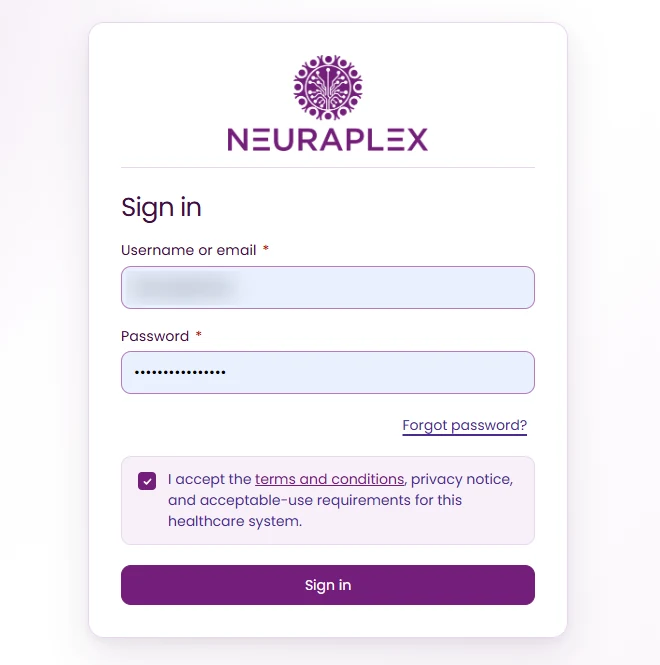
Secure sign-in
Staff sign in with their own account and accept the terms, privacy notice and acceptable-use requirements.
- 2
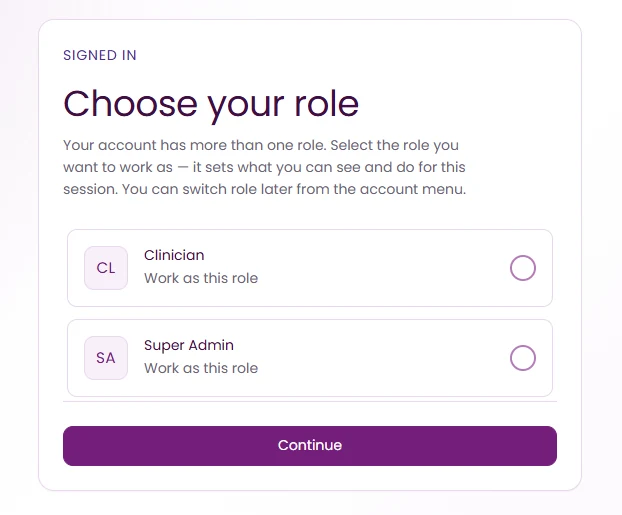
Role-based access
Staff with more than one role choose one for each session. The role sets what they can see and do.
- 3
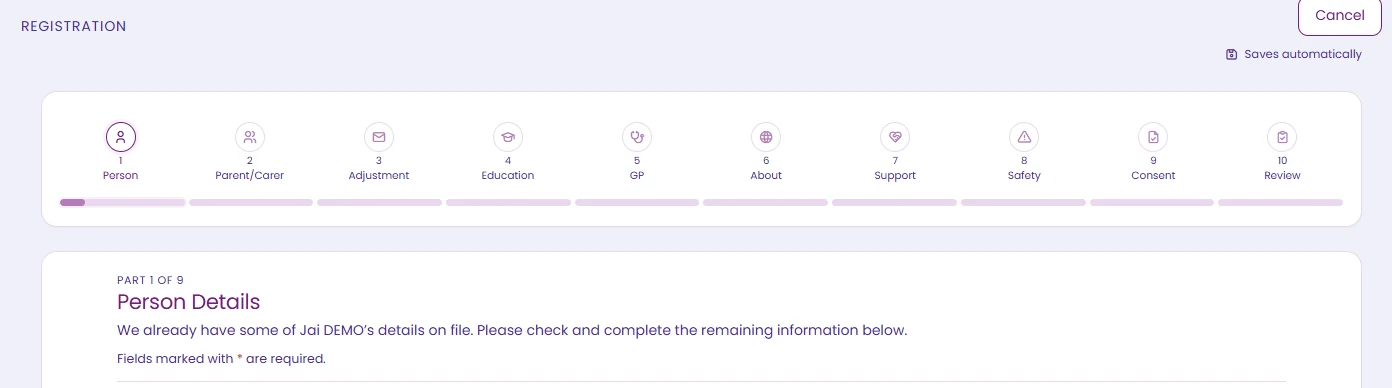
Registration
Families check the details already on file and complete the rest across ten short parts, including adjustments, education, GP, safety and consent. It saves automatically.
- 4
Pre-assessment: getting started
The first question asks whether support or adjustments are needed before the form is completed. Families can pause and return at any time.
- 5
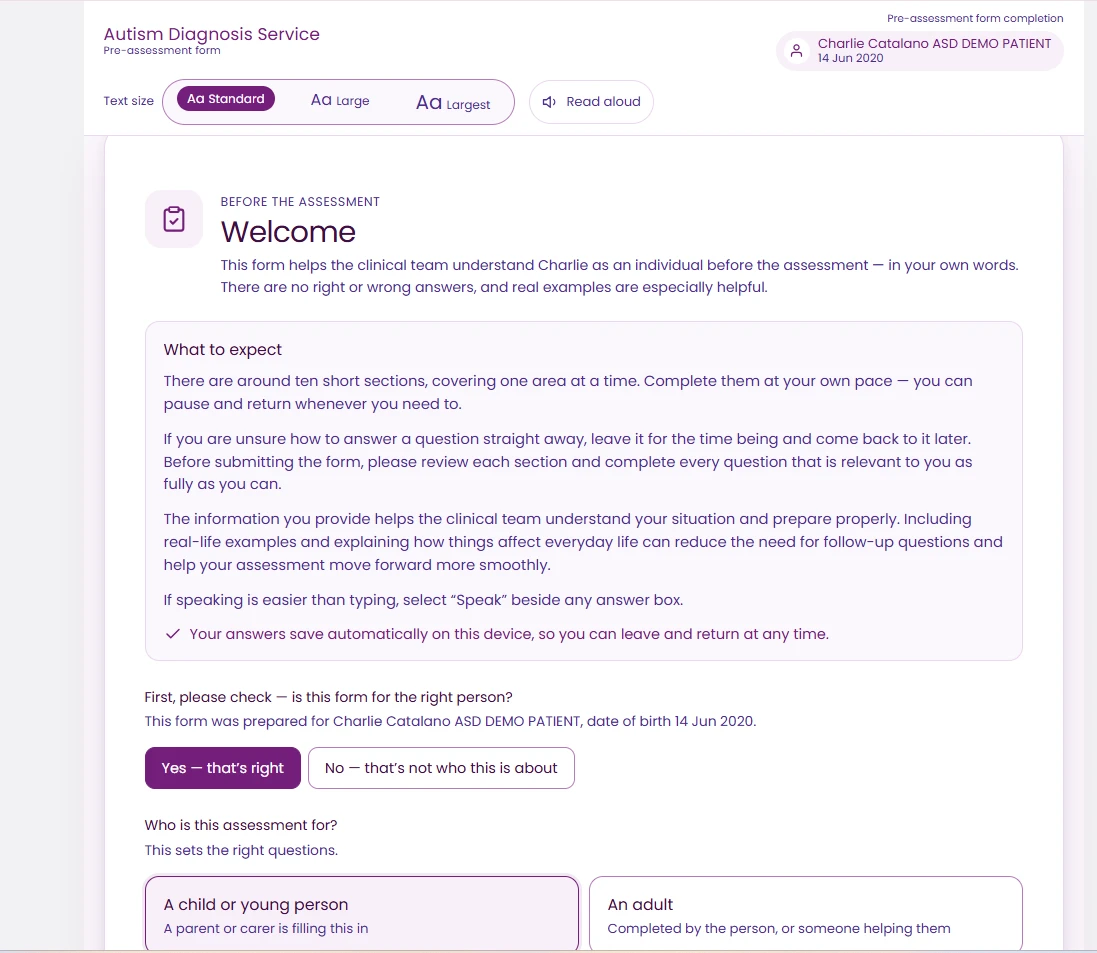
Inclusive design
Information is shown to the person and their family in easy-to-understand sections, with no time pressure. Forms can be completed when it suits them and respond to their answers and situation. Neuraplex respects each person's gender identity, allows time to process, and is supportive throughout. The pre-assessment form includes text size and read-aloud options.
- 6
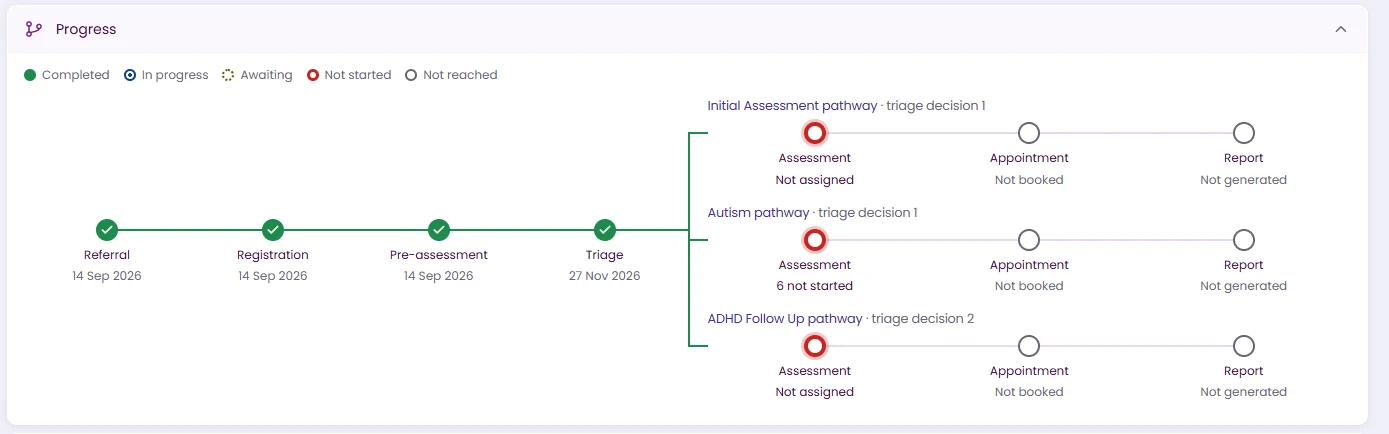
Pathway progress
Each patient's record shows progress from referral to triage. After triage, it branches into every pathway agreed at triage, with assessment, appointment and report status for each.
- 7
Clinician live view
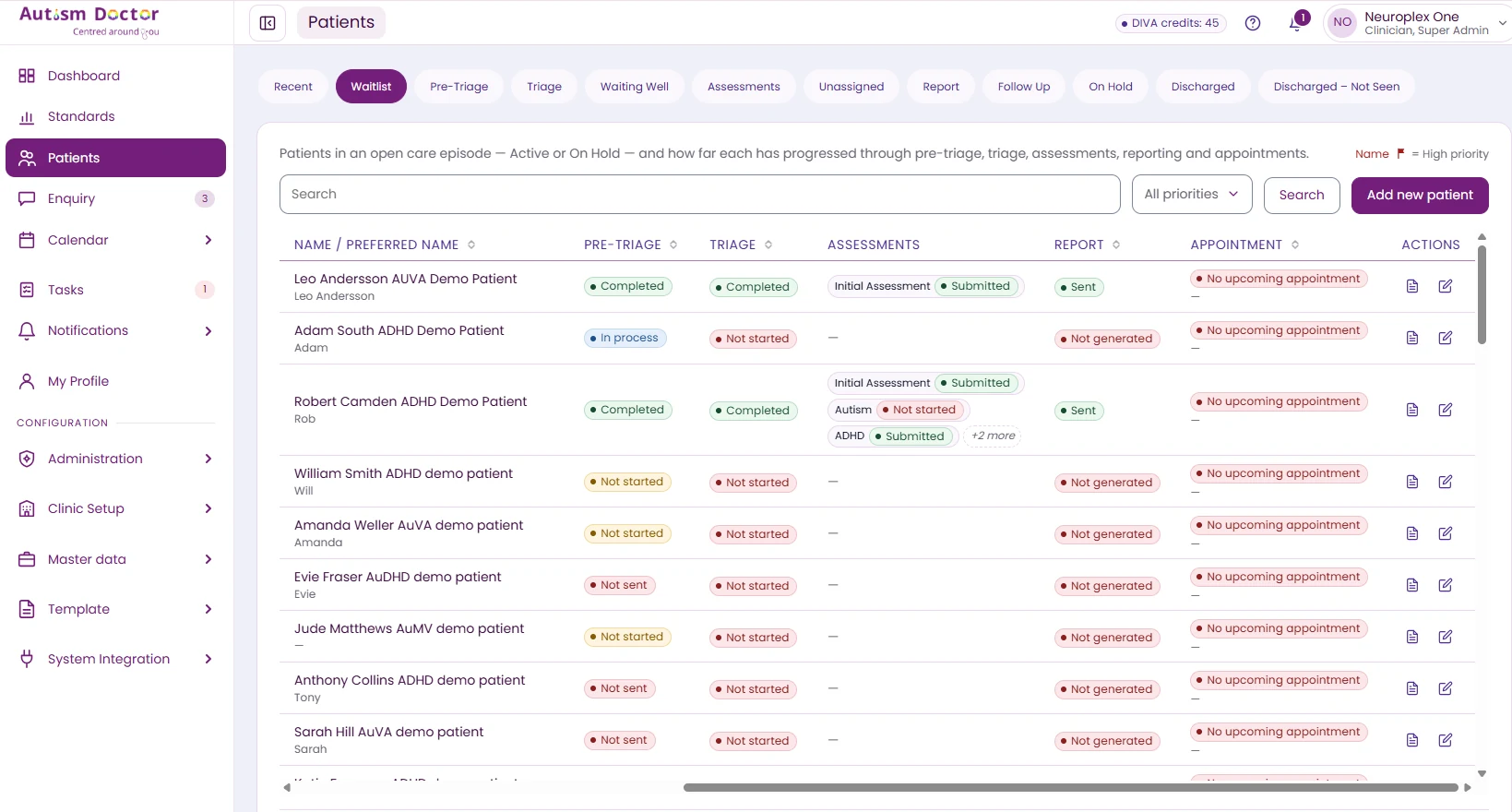
Clinicians see every patient in an open care episode, with the status of pre-triage, triage, assessments, report and appointments. Tabs filter by stage, from waitlist to discharge.
- 8
Service oversight
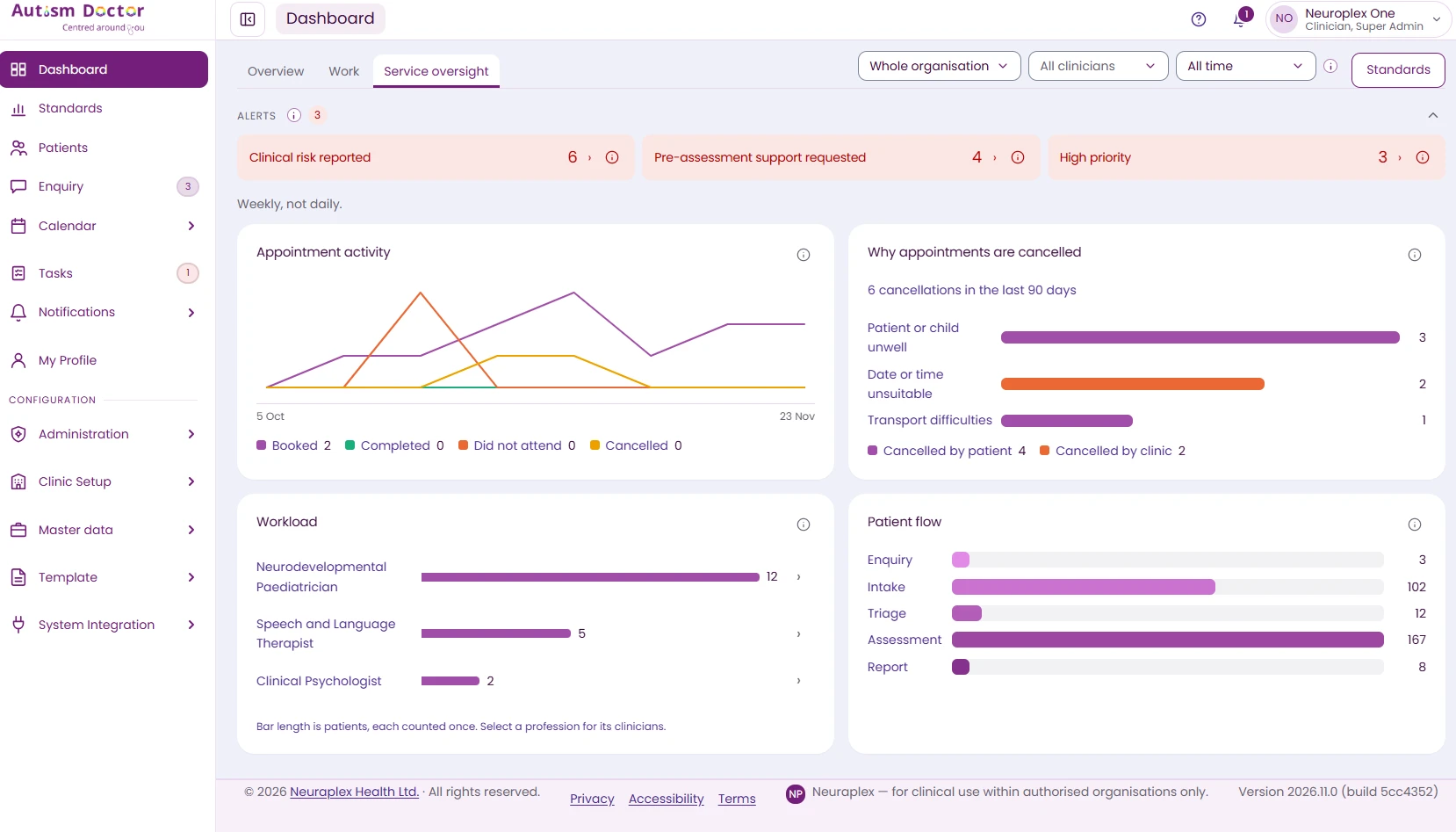
Service managers see what needs attention now: alerts for clinical risk, support requests and high priority, workload by profession, why appointments are cancelled, and how patients flow from enquiry to report.
All functions
Access and preparation
1. Digital Front Door
- Online enquiries, referrals and registration
- Clear pathway information
- Demographic and contextual details
- Consent and information-sharing preferences
- Accessibility needs and reasonable adjustments
- Confidential information management
- Automated reminders
- Referral completeness checks
- Progress visible to families
- Flags people who need extra help to access the service
Digitally enabled, not digital-only.
2. Digital pre-assessment
- Questionnaires for patients, parents, carers and schools
- Developmental, medical, family and social histories
- Condition-specific screening tools and rating scales
- Functional difficulties across settings
- Automated scoring where permitted
- Autosave and completion over several sessions
- Missing-information checks and reminders
- Voice-to-text to minimise the cognitive load on completers
3. Clinical triage
- Surfaces information at the point of care, highlighting any safeguarding concerns and vulnerabilities for review
- Structured review of referral and pre-assessment information
- Co-occurring conditions surfaced for review
- Needs-based prioritisation
- Allocation to standard, enhanced or combined pathways
- Clinical rationale recorded
Decisions stay with qualified clinicians.
4. Waiting Well
- Waiting list size, duration and status
- Automated communications and validation
- Periodic wellbeing check-ins
- Changing clinical, educational and social needs
- Priority groups
- Non-responders and disengagement
- Escalation for clinical review
- Education, resources and community signposting
Support is needs-led, not dependent on a diagnosis.
5. Scheduling and workforce
- Clinician allocation and caseloads
- Face-to-face, remote and hybrid appointments
- Professional responsibilities
- Booking deadlines
- Clinician dashboards
- Outstanding tasks and assessments
- Automated appointment messages
- Report completion
- Delays and bottlenecks
- Supports skill mix
Assessment and diagnosis
6. Purpose-built assessment pathways
- Initial developmental assessment
- Standard and enhanced autism assessment
- ADHD
- Combined autism and ADHD
- Developmental coordination disorder assessment
- Broader neurodevelopmental conditions
- Autism follow-up
- ADHD medication initiation, titration and long-term monitoring
- Post-diagnostic support
- Discharge and transition
- NICE-informed assessment templates
Structured, while leaving room for clinical judgement.
7. Standardised instruments
- Screening questionnaires and rating scales
- Structured diagnostic interviews including DIVA-5 and Young DIVA-5
- Autism diagnostic frameworks
- Developmental history tools
- Functional impairment and co-occurring condition measures
- Outcome measures
- Automated scoring where permitted
Neuraplex works with tool developers and licence holders, and respects each instrument's content, scoring, copyright and licensing.
8. Multidisciplinary collaboration
- Shared access to relevant information
- Structured contributions from each clinician
- Developmental histories and observations
- Education reports and school observations
- Diagnostic findings
- MDT discussion and formulation
- Outstanding components tracked
- Internal and external providers coordinated
9. Diagnostic recording
- Primary and secondary diagnoses
- Confirmed and provisional diagnoses
- Diagnostic criteria used
- Supporting evidence and formulation
- Diagnosing professional
- Discussions with patients and families
- Co-occurring conditions
- Non-diagnostic outcomes
- Audit and outcome reporting
Treatment, support and documentation
10. Clinical documentation and automation
- Voice-to-text
- AI-assisted grammar and spelling
- Summarisation
- Recipient-specific rewriting
- Structured report generation
- Personalised correspondence
- Patient and parent-facing reports
- Reusable templates and recommendations
- Ambient voice technology*
Clinicians review, edit and approve every output.
*In development
11. ADHD medication management
- Medication history and prescribing records
- Initiation and titration workflows
- Treatment response
- Symptom and side-effect monitoring
- Height, weight, blood pressure and pulse
- Review reminders
- Prescription management
- Controlled drug safeguards
- Pharmacy communications
- Shared care documentation
Integrated with an online pharmacy in the private setting.
12. Post-diagnostic support
- Personalised recommendations
- Patient and family education
- Curated resources
- Local and national signposting
- Recommendations for schools
- Self-management resources
- Needs-based follow-up
- Onward referral
- Discharge planning
- Transition to adult services
Service intelligence and configuration
13. Operational and commissioning insight
- Referral volumes and trends by pathway
- Workforce capacity and utilisation
- Capacity modelling
- Waiting list size, median and longest waits
- Waits by stage and bottlenecks
- Turnaround and report times
- Patient engagement
- Completion rates and diagnostic outcomes
- Variation, medication monitoring, PREMs and audit
- Internal, outsourced and Right to Choose provider activity
- Equity of access, waits and outcomes by age, sex, ethnicity, deprivation, locality, language, disability, reasonable adjustments, education status and vulnerable groups
14. Configurable pathways
- Referral and registration
- Pathways
- Questionnaires and templates
- Appointment types
- MDT requirements
- Professional roles
- Admin workflows
- Patient communications
- Reporting
- Post-diagnostic resources
Services standardise their processes without being forced into one delivery model.
Neuraplex
Evidence
Results from four years of real-world use.
Evidence and outcomes
In brief
- Over four years in an independent clinical service, nearly 1,300 patient journeys have been supported by Neuraplex
- Clinician time per autism assessment is 5–6 hours, against a national average of about 11.5 hours
- In a six-month evaluation from May to November 2025, 96% of autism assessments (55 of 57) and 93% of ADHD assessments (27) were completed within 28 and 17 days respectively, measured from first appointment to diagnostic feedback
- These results come from one independent service. The next step is evaluation in NHS services
Development draws on NICE guidance, multidisciplinary assessment principles and four years of delivering neurodevelopmental care.
| Measure | Result |
|---|---|
| Patient journeys supported | Nearly 1,300 |
| Real-world clinical use | About 4 years |
| Autism assessments completed within 28 days | 96% (55 of 57) |
| ADHD assessments completed within 17 days | 93% (n=27) |
| Clinician time per autism assessment | 5–6 hours |
| Clinician time per ADHD assessment | About 2 hours |
| Median registration to first appointment | 11 days (n=320) |
| Median first appointment to diagnostic feedback | 21 days |
| Median registration to diagnostic feedback | 34 days |
| Median diagnostic feedback to report completion | 4 days |
Neuraplex
Safety
Clinical safety, information governance and assurance.
Clinical safety and governance
Neuraplex is developed within, and is working towards assurance against, UK clinical safety, information governance and digital assurance frameworks, including DCB0129, UK GDPR, Cyber Essentials, DSPT and DTAC. Clinicians remain responsible for every clinical decision.
| Area | Framework |
|---|---|
| Clinical safety |
|
| NHS assurance |
|
| Data protection |
|
| Security and access |
|
| AI oversight |
|
| Accessibility | WCAG 2.2 AA |
Neuraplex
Integration
What is live now and what is in development.
Integration
Neuraplex works alongside existing healthcare systems, bringing established tools and instruments together in one neurodevelopmental pathway rather than replacing them.
Integration with
- Online pharmacy integration (private setting)
- Coordinated prescribing and medication fulfilment
- Built-in clinical voice-to-text
- Clinician-controlled AI-assisted documentation
- Structured clinical information capture
- Cross-platform access
- Ambient voice technology (AVT) providers*
- DIVA-5 and Young DIVA-5, subject to licensing*
- Third-party questionnaires and outcome measures*
- Electronic Patient Records (EPRs)*
- Primary care and shared care systems*
- Structured data exchange and data portability*
- Wider prescribing and pharmacy services*
- Alignment with professional record standards*
*In development
Technical specifications, architecture, integration and security documentation are available on request.
Neuraplex
Implementation
How Neuraplex is set up in your service, step by step.
- 1
First conversation and demonstration
We understand your service, your pathways and what you want to achieve, and show you Neuraplex working with made-up information.
- 2
Agreement
Terms are agreed, including data protection arrangements and a data processing agreement. Neuraplex provides its DCB0129 clinical safety documentation to support your DCB0160 deployment and your DPIA.
- 3
A trial with made-up information
Your organisation has its own separate environment. Staff try Neuraplex using made-up information only, so no real patient data is used before go-live.
- 4
Configuration
Neuraplex is set up for your service: pathways, appointment types, forms, letters, Waiting Well intervals and your organisation’s details on letters and reports. The core product stays the same for every organisation.
- 5
Users and training
Your administrator invites staff within the agreed number of users. Staff sign in with their work email, a password and multi-factor authentication, and complete mandatory training before they can use Neuraplex with patients.
- 6
Go live with support
Your team starts using Neuraplex with patients, with support by phone and email during working hours.
- 7
Review and improve
We review how it is working with you after the first weeks. Ideas for new features go through a clear request and review process.
What your organisation provides
- A senior sponsor and a clinical lead
- An information governance lead for the DPIA and data protection checks
- A clinical safety officer for your DCB0160 deployment
- An administrator to set up users and local details
- Your current pathway documents, forms and letter templates
Working alongside your record system
Neuraplex works alongside your existing electronic patient record. How reports and letters are copied into your record system is agreed with you during implementation.
Two-way integration using FHIR is planned, so that staff can stay in their own system while information flows to and from Neuraplex.
Training
- Mandatory training before staff use Neuraplex with patients
- A pass mark for clinical safety modules
- A first-use check signed off by the line manager
- Refresher training every year, and guidance after major updates
Support
- A dedicated support phone line and email
- Support during working hours, on working days
- Help with configuration, users and training throughout implementation
Timescales are agreed with each organisation and depend on the pathways, number of users and local approvals.
Neuraplex
Commercial
What your service could achieve, and how Neuraplex is commissioned.
Commercial model
Neuraplex is delivered as software as a service, on a subscription that scales from independent clinicians to large commissioned services.
| Included in the model |
|
| Suitable for |
|
| Potential savings |
|
The Neuraplex difference
Neuraplex is built around neurodevelopmental care, rather than asking neurodevelopmental care to fit a digital platform. It connects four levels of impact.
- An inclusive front door
- A clear, structured journey
- Speech-to-text for completing forms
- Visible progress
- Needs-based support before and after diagnosis
- Integrated assessment pathways
- MDT collaboration
- NICE-informed templates
- Technology matched to each assessment and each clinician's way of working, such as voice-to-text, structured templates and ambient voice technology*
- Automated documentation
- Workforce coordination
- Prescribing and long-term monitoring
- Standardisation and quality assurance
- Capacity and waiting list insight
- Provider oversight
- Inequalities monitoring
- Evidence-informed commissioning
- Sustainable pathways
- Less travel and paper
- Free resources
*In development
Neuraplex
Equality and inclusion
Equality, diversity, inclusion and co-design.
Equality, diversity and inclusion
Every child and family should receive the same quality of care, whatever their background, ethnicity, language, disability, income or digital access.
- Shaped with neurodivergent people, parents with English as an additional language and young people, as well as other users
- Digitally enabled, never digital-only: forms can be completed online, on paper or by phone, or with help for anyone who needs it
- Interpreter, communication and accessibility needs recorded from first contact
- A prototype of the parent pre-assessment form in Urdu and Romanian, the two languages most needed for parental form completion
- Facilitating reasonable adjustments is an integral part of Neuraplex
- Access, waiting times and outcomes can be checked by ethnicity, deprivation, language, disability and locality, so unequal access is made visible and services can act on it
Co-designed with the people who use it
Neuraplex has been shaped through workshops and continuous feedback from neurodivergent people, children, young people and adults, parents and carers, clinicians with lived experience of neurodivergence, multidisciplinary professionals, schools and service teams.
| Designed for | How |
|---|---|
| Lower cognitive and sensory load |
|
| Reasonable adjustments |
|
| Digital inclusion |
|
| Digital accessibility |
|
Neurodivergent people are not one group. Neuraplex continues to evolve through real-world use, workshops and feedback, guided by both lived experience and clinical practice.
Neuraplex
NHS
How Neuraplex supports a greener NHS, the NHS priorities and social value.
A greener NHS
Neuraplex supports NHS England's net zero ambition: an 80% cut in directly controlled emissions between 2028 and 2032, net zero for those emissions by 2040, and for wider emissions by 2045.
| Lever | How Neuraplex helps |
|---|---|
| Less travel for families |
|
| Paper-lite pathways |
|
| Less wasted resource |
|
| Responsible digital |
|
Digital services have their own footprint, so Neuraplex will measure rather than assume its benefit: journeys and mileage avoided, printing and postage saved, repeat appointments avoided, digital infrastructure emissions, and net carbon per completed pathway.
NHS priorities
Neuraplex contributes to each of the NHS's three strategic shifts and to its wider ambitions.
| NHS priority | Neuraplex contribution |
|---|---|
| Analogue to digital | Digital Front Door, digital pre-assessment, connected workflows and automation |
| Hospital to community | Community-based, remote and hybrid pathways |
| Sickness to prevention | Waiting Well, monitoring of changing needs, early support |
| Shorter waits | Pathway coordination, clinical productivity, capacity insight |
| Workforce sustainability | Less repeated work, administrative efficiency, MDT collaboration |
| Fewer health inequalities | Inclusive design, reasonable adjustments, equity reporting |
| Personalised care | Needs-based pathways, individual recommendations, patient-centred communication |
| A greener NHS | Less travel, paper-lite workflows, responsible digital development |
| Social value | Equitable access to resources and accessible information |
Neuraplex
FAQs
Answers to the questions we are asked most often.
Does Neuraplex diagnose or recommend treatment?
No. Neuraplex supports pathway management, information gathering, workflow coordination and clinical documentation. Clinicians make every clinical decision, and review and approve every report.
Does Neuraplex replace our electronic patient record?
No. Neuraplex works alongside your existing record system. Two-way integration using FHIR is planned.
Where is the data stored?
Data is hosted securely in the United Kingdom. Data protection arrangements, including each party’s responsibilities, are set out in a data processing agreement with your organisation.
What clinical safety and assurance work is in place?
Neuraplex is developed in accordance with DCB0129, UK GDPR, Cyber Essentials, DSPT and DTAC. Neuraplex supports your organisation’s DCB0160 deployment.
Which pathways does Neuraplex support?
Autism, ADHD and combined autism and ADHD assessments; ADHD medication initiation, titration and follow-up; initial assessment, developmental delay and developmental coordination disorder.
Does Neuraplex work for adults?
Neuraplex was built around children and young people and supports adults too. Adult pathways are developing.
Can we use our own forms, letters and pathways?
Yes, within Neuraplex’s configuration options. The core product stays the same for every organisation, so it remains safe and supported. New feature ideas go through a request and review process.
How is AI used?
Clinician-controlled tools include voice-to-text, grammar and spelling checks, summarisation and rewriting for patient-centred reports. Clinicians review, edit and approve every output.
What about families who cannot use digital forms?
Neuraplex is digitally enabled, never digital-only. Forms can be completed online, on paper or by phone, with help for anyone who needs it.
How do staff sign in?
With their work email, a password and multi-factor authentication. Each person sees only what their role allows.
Can we try Neuraplex first?
Yes. After a demonstration, your organisation can try Neuraplex in its own separate environment using made-up information only.
How much does Neuraplex cost?
Pricing depends on the size of your service and the pathways you use, and is discussed during your demonstration.
Have a question that is not answered here? Email info@neuraplex.co.uk.

Dr Deepshikha Thakur
Founder and CEO, Neuraplex
Consultant Neurodevelopmental Paediatrician with more than 20 years’ experience.
Neuraplex is here as a supporting tool to influence what the leaders and visionaries in the NHS are already trying to achieve.
Fair, accessible and timely care for everyone, including children and families, whatever their background, delivered by an NHS workforce enabled to do more, and better.
“The NHS is the most extraordinary health service in the world because of its people. Its senior leaders, clinicians and administrators already have the vision to transform neurodevelopmental care. Neuraplex is here to support them.”
With thanks
“The credit for Neuraplex belongs to every child and family I have met in my journey as a paediatrician. I have listened carefully to what they told me and tried to bring it to life. I am also deeply grateful to my clinical colleagues, whose skill, compassion and generosity with their ideas have shaped every part of it.”
“Being part of the NHS Clinical Entrepreneur Programme has been one of the most valuable experiences of my career. The mentoring, the honest challenge and the community of clinicians who want to make things better have shaped how I think about innovation in the NHS, always starting with patients and the people who care for them.”
Dr Deepshikha Thakur, Founder and CEO, NeuraplexClinical career
- Consultant Neurodevelopmental Paediatrician
- Clinical Director and Clinical Autism Lead, Hertfordshire Community NHS Trust
- Principal Investigator, NIHR-funded KASPAR trial
- Co-chair, East of England Autism Subcommittee
- 20+ years in neurodevelopmental paediatrics
Qualifications
- MBBS
- MD (Paediatrics)
- MRCPCH
- Postgraduate Diploma in Neurodisability
Accredited in
- ADOS-2
- ADI-R
- 3Di
- BOSA
- TELE-ASD-PEDS
Training
- QbTest training
- Conners 4 training
- ADHD history-taking training
Recognition
- Chairman's Outstanding Leadership Award, Hertfordshire Community NHS Trust, June 2024
- NHS Clinical Entrepreneur (Cohort 10)
NHS roles are listed as career history and do not imply NHS endorsement of Neuraplex.
Neuraplex
Contact
How to reach us, and our company details.
Company details
Neuraplex is a product of Neurodevelopmental Services Limited.
Company number 12197807
Registered office: Asm House, Keymer Road, Hassocks, West Sussex, BN6 8QL
ICO registration: ZA560187
Neuraplex
Privacy
How this website and Neuraplex handle personal information.
This website
This website does not ask you for personal information, does not use cookies and does not use tracking or advertising tools.
It loads the Poppins typeface from Google Fonts, which means your browser connects to Google’s servers to download the font.
If you contact us
If you email or phone us, we use your details only to reply to you and to arrange any demonstration you ask for.
The Neuraplex platform
Patient and staff information in Neuraplex is hosted securely in the United Kingdom. Each organisation using Neuraplex has a data processing agreement with us, and its own privacy notice for patients and families.
Neurodevelopmental Services Limited is registered with the Information Commissioner’s Office, registration number ZA560187.
Questions
Email info@neuraplex.co.uk with any question about privacy or to ask for our full privacy notice.
Neuraplex
Accessibility
How we make this website and Neuraplex accessible.
Our aim
We want everyone to be able to use Neuraplex and this website. We design to the Web Content Accessibility Guidelines (WCAG) 2.2 at level AA.
This website
- Text and background colours are checked to meet WCAG 2.2 AA contrast
- Every page can be used with a keyboard
- Animations are reduced if your device is set to reduce motion
- Pages work on phones, tablets and computers
Known limitations
- Screenshots of the platform include small text. Each has a written description, and the same information is set out in the text beside it
The Neuraplex platform
An internal WCAG 2.2 AA accessibility audit of the platform was completed in October 2026. The platform includes adjustable text size, read-aloud, plain English and consistent navigation.
Report a problem
If you find something hard to use, email info@neuraplex.co.uk. We aim to respond within four weeks.
Social value
Neuraplex aims to grow as a socially responsible organisation, so that good information and support do not depend on a diagnosis or on being able to pay for private care.
Accessible knowledge
As Neuraplex grows, it plans to report transparently on free resources, people reached and progress on sustainability.